
Running a Sex Offender Check in O'Brien County
The Iowa Sex Offender Registry, operated by the Iowa Department of Public Safety and Division of Criminal Investigation, is the first official channel for an O'Brien County sex offender check. It publishes the information that Iowa Code chapter 692A makes public. The O'Brien County Sheriff's Office is the local registration point, while DCI maintains the central system. These roles matter. The registry is best for a public search; the sheriff is best for registration instructions, a suspected compliance issue, or added information that state law permits the sheriff to release.
Start with facts that can separate results. A full or partial name may work, but an alias check and a five-digit ZIP filter can help. Map search is useful for place-based awareness. Telephone and email tools answer a narrower question about whether those details are tied to a published registrant. Results can change as a person moves, completes a registration term, enters custody, or has a court order modified. Save the date and method of the search when the timing matters.
O'Brien County Registry Redesign
Iowa launched a redesigned registry on August 22, 2025, while keeping the same main web address. The DPS launch notice highlights stronger search tools, interactive maps, helpful tips, and direct paths to active and most-wanted records. That change makes an old bookmark to a deep search page less reliable than the main registry home. Begin at the official domain and use the current tabs shown there.
The official Iowa registry landing page shows the current public entry point for an O'Brien County registry search.
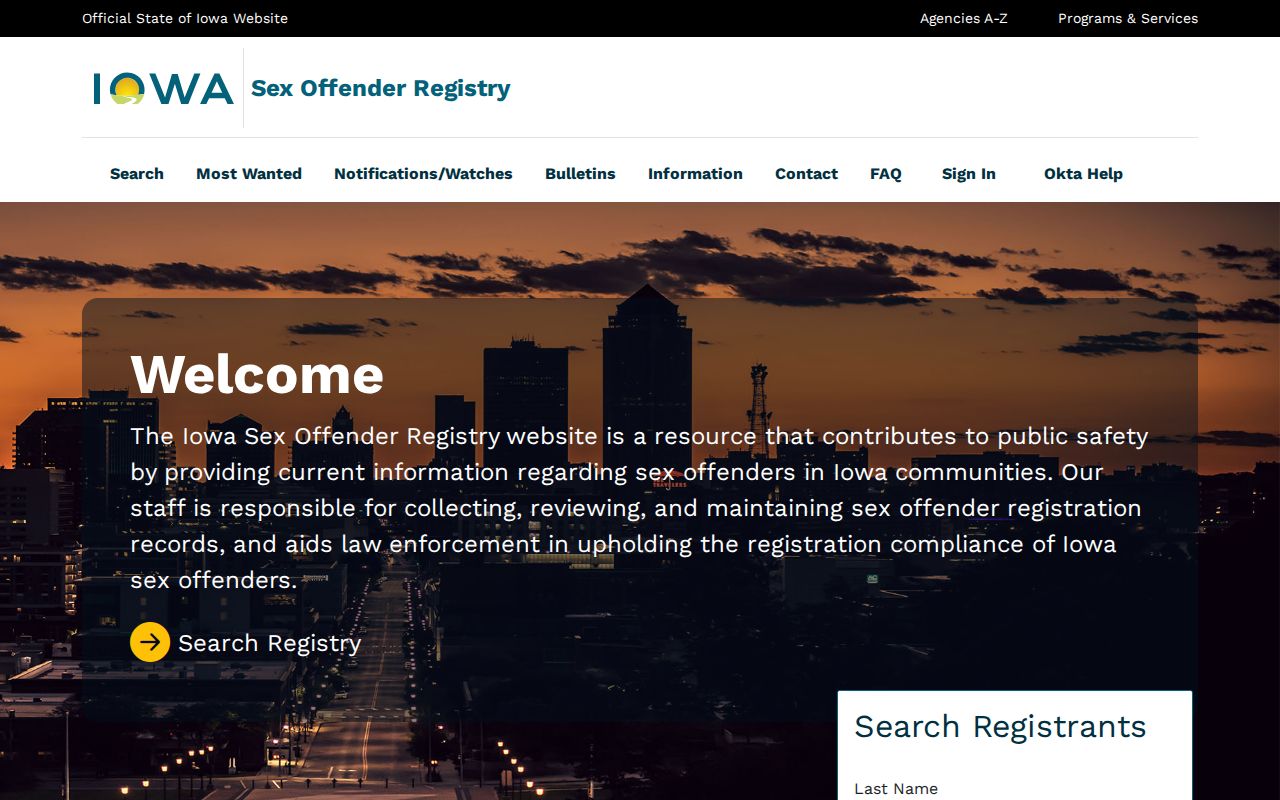
The neutral search screen keeps the focus on controls, not on the identity or private details of any registrant. It also helps a reader confirm that the page is still on Iowa's government-run system before entering search terms.
Searching the Iowa Sex Offender Registry
The registry offers several ways to narrow an O'Brien County sex offender check. Basic name and ZIP controls are the simplest. Advanced and map tools add wider criteria, while the telephone and email tabs can test whether a specific contact detail is associated with a public record. No single field is required for every type of search, so use known facts and avoid guessing at a person's identity.
- Open the official Iowa registry and read its public notice, limits, and lawful-use terms.
- Choose basic, advanced, map, telephone, or email search based on the fact you need to verify.
- Enter the known fields, include aliases when relevant, and review results for a sound match.
- Open the public profile, check its status and source details, then contact law enforcement instead of confronting anyone.
The current O'Brien County registry controls documented in the state system include the following fields and links:
| Field Label | Type | Required | Options or Notes |
|---|---|---|---|
| Last Name | Text | No | Basic registrant search |
| First Name | Text | No | Basic registrant search |
| Also Search Aliases | Checkbox | No | Expands a name search |
| Zip Code | Text | No | Five-digit place filter |
| Advanced Search | Tab or link | No | Offers wider criteria and tips |
| Map Search | Tab or link | No | Supports a geographic search |
| Telephone Search | Tab or link | No | Checks a phone association |
| Email Search | Tab or link | No | Checks an email association |
O'Brien County Registry Watches
A saved watch is more useful than repeating the same O'Brien County offender lookup by hand. With an Okta account, the registry allows watches based on city, county, ZIP code, a specific address and radius, or a registrant or group. Iowa does not promise individual doorstep notice for each change. The watch tool is the public channel for an alert tied to the area or record the user selects.
Registry data updates daily and may refresh as often as every 30 minutes on weekdays, excluding holidays. The state says an email watch notice should issue within 60 minutes after registered information changes. That schedule is fast, but not truly live. A move, correction, or new filing may still take time to pass from the O'Brien County sheriff to the DCI system and then into an alert.
The state registry's official search FAQ explains update timing, watches, and search limits.
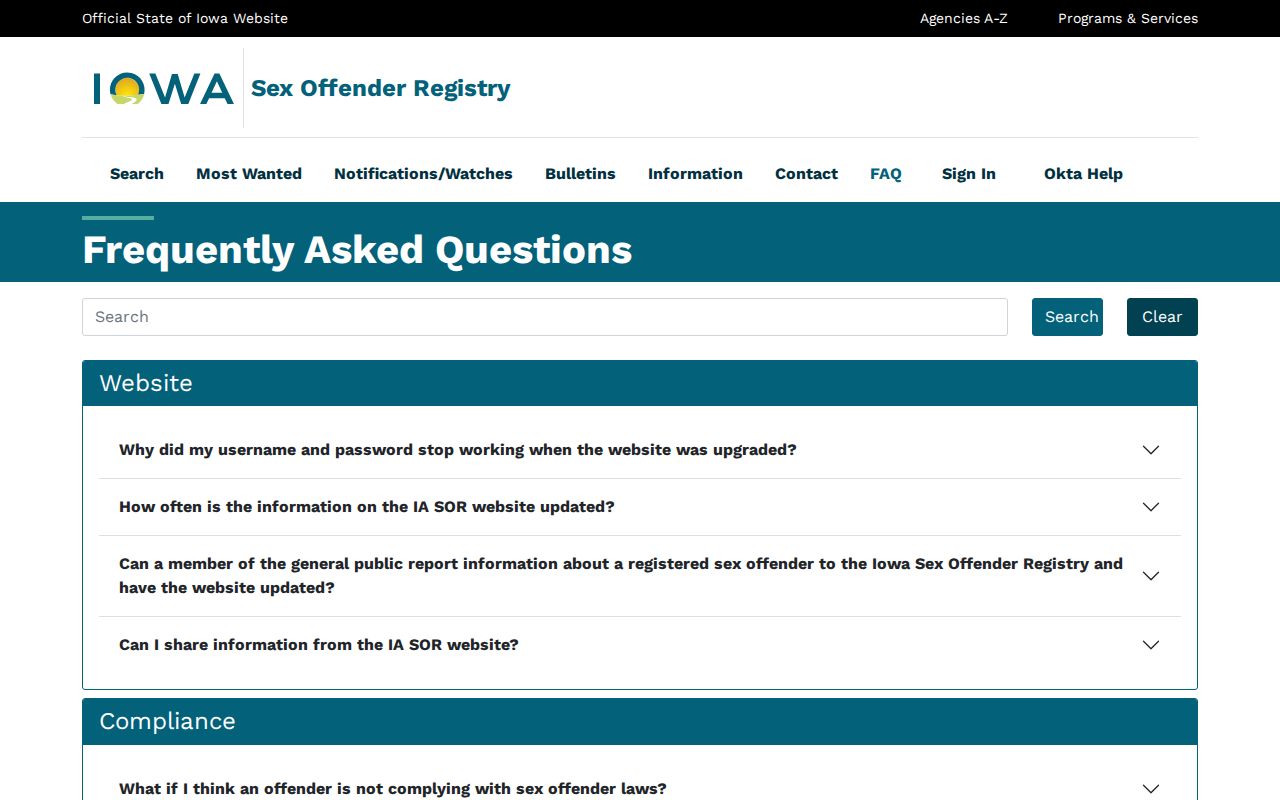
Those timing rules make a watch useful for ongoing awareness, while a new search remains the better choice when a reader needs the current public result at once.
What a Registry Profile Shows
An Iowa public profile can combine identification, location, offense, and registration facts. Read the fields as a linked set. A name alone does not establish a match, and a map point does not tell the full legal history. Chapter 692A.121 defines the public dataset. The O'Brien County sheriff may hold added information that can be requested under that section even when it is not shown on the public profile.
| Name & Aliases | Published identity names and known aliases used to distinguish records. |
|---|---|
| Photo & Description | A registry photograph and public physical descriptors used for identification. |
| Residence or Location | Public residence or location information allowed by Iowa law. |
| Qualifying Offense | The offense, conviction jurisdiction, and related conviction information. |
| Tier | Tier I, II, or III classification tied to statutory duties. |
| Registration Status | Current published standing, including an active or wanted status where shown. |
Telephone and email verification, maps, and the most-wanted list are separate tools, not extra profile fields. Keep their results in context. If a public record seems to identify the wrong person or show stale data, report the issue to the sheriff or DCI rather than republishing it.
O'Brien County Registry Result Limits
“Not found” does not mean a person was never required to register or never had a qualifying case. The term may have ended. The person may be dead, incarcerated, outside Iowa, or subject to a reversed conviction, set-aside, court modification, or juvenile waiver. Some offenses do not trigger registration. Iowa also warns that the public site does not contain the full list of all registered offenders in the state.
The active and most-wanted paths answer different questions. Active records concern current published registration. Most wanted highlights some people sought for noncompliance; it is not a full list of all O'Brien County violations or warrants. The official Iowa registry most-wanted page illustrates that separate state channel.
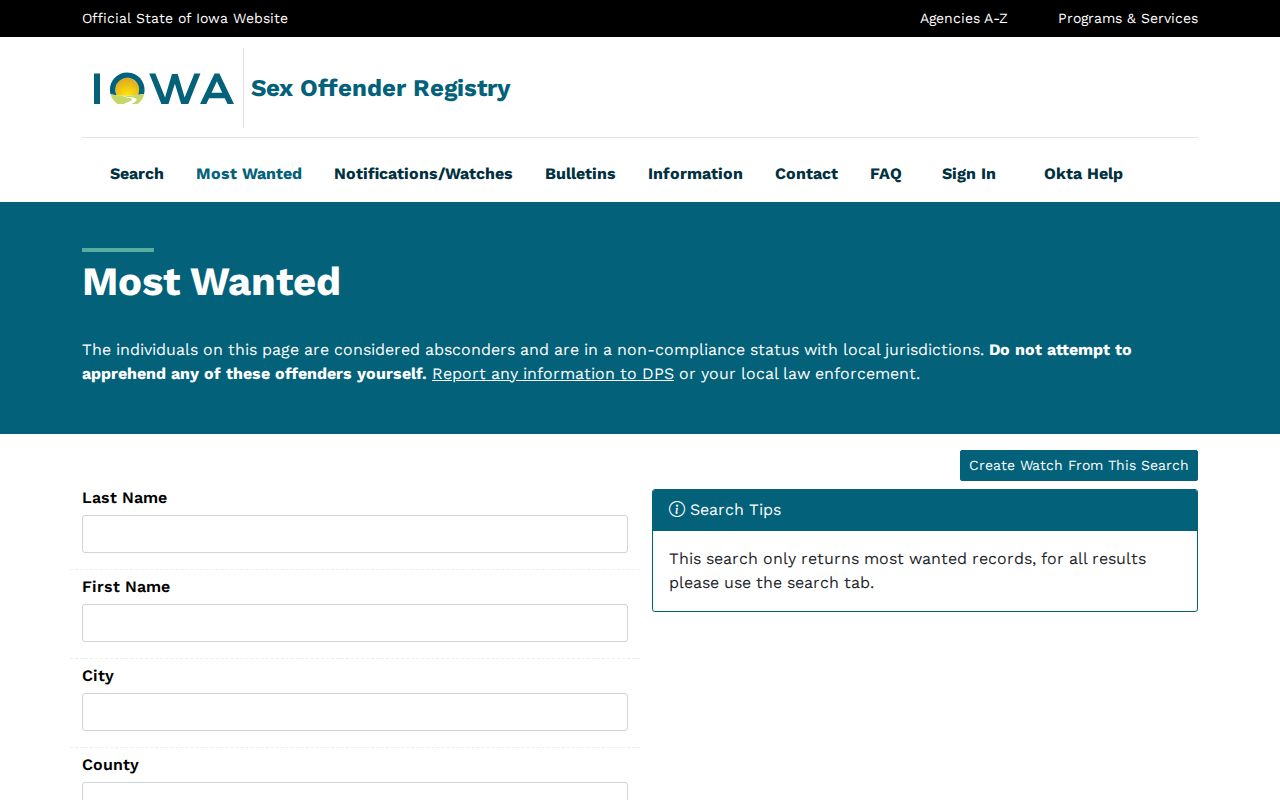
A missing name on that list should not be treated as a compliance finding. Ask the O'Brien County Sheriff's Office about suspected noncompliance, or use the registry contact path for a tip. Call 911 only for an emergency.
Registration Requirements and Levels in Iowa
Iowa assigns Tier I, II, or III duties under chapter 692A. The tier affects the general registration term and how often the person must verify information. Exact rules depend on the offense, repeat-offense provisions, court orders, and current statute. Iowa Code sections 692A.106 through 692A.108 govern duration, tolling, and verification. A registration period stops running while a person is incarcerated.
| Iowa Tier | General Duration | Verification |
|---|---|---|
| Tier I | 10 years | At least annually; confirm the offense-specific rule |
| Tier II | 10 years | At least every six months under the tier scheme |
| Tier III | Life | At least every three months under the tier scheme |
A repeat offense can move Tier I to Tier II or Tier II to Tier III. Section 692A.128 also provides a court process to seek modification when its elapsed-time, treatment, risk, supervision, and conviction-free standards are met. A public profile is a status record, not a full explanation of how every duty was calculated.
O'Brien County Registration Office
People who register outside prison do so through a county sheriff. The O'Brien County Sheriff's Office takes local registrations in Primghar, sends the information to DCI, and handles local compliance questions. Iowa Department of Corrections staff register a person before release from a correctional facility. Anyone with a registration duty should call the sheriff for appointment and document instructions instead of relying on a public search result as procedural advice.
O'Brien County Sheriff's Office
240 1st Street NE
Primghar, IA 51245
712-957-3415
Local registration, compliance reports, and lawful requests for added registry information.
Iowa DCI Registry
215 E 7th Street
Des Moines, IA
515-725-6050
Central registry contact: sorinfo@dps.state.ia.us.
Suspected noncompliance belongs with local law enforcement or the registry's contact and tip channel. Give clear facts, but do not investigate, follow, or confront the person. The sheriff can determine whether the report reflects a missed duty, a lag in public data, or a record that is not publicly visible.
O'Brien County Cross-State Checks
An Iowa-only result cannot show every registration in another state or territory. If a person has left O'Brien County, has lived in more than one state, or cannot be found in Iowa, use the U.S. Department of Justice's National Sex Offender Public Website. NSOPW sends one search across participating public registries. It remains a public-record layer, not a national criminal-history report, and each jurisdiction controls the information it contributes.
The official NSOPW search provides the cross-state registry path for an O'Brien County safety check.
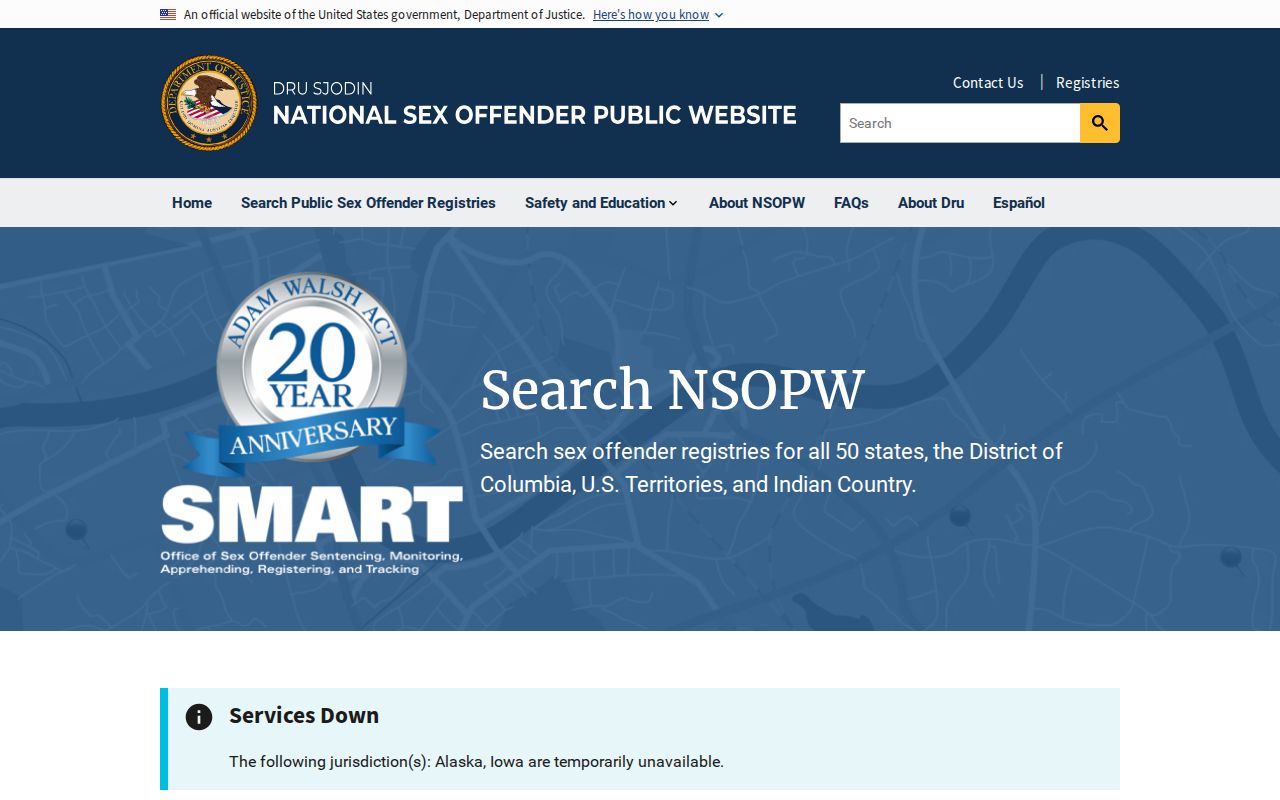
Open the source registry behind a match to read its terms and latest public status. If the location points back to Iowa, compare it with the Iowa profile and ask the O'Brien County sheriff about a material conflict.
O'Brien County Registry Residency Rule
Iowa Code §692A.114 generally bars a person convicted of a covered aggravated offense against a minor from living within 2,000 feet of school or child-care property. The rule has listed exceptions, so a map pin near such a site does not by itself prove a violation. Section 692A.113 separately governs certain exclusion zones and activities. Local officers and the courts apply the law to the facts.
Registration fees and civil penalties fall under §692A.110. Failure to comply and false information are addressed by §§692A.111 and 692A.112. These rules explain why the O'Brien County registry and sheriff channels work together: the website provides public notice, while trained officials assess a report, confirm an address, and enforce a legal duty.
Lawful Use and Community Notification
Registry information is for public protection and awareness. An O'Brien County resident can use it to plan family safety, understand nearby public records, create a location watch, or give a factual tip to law enforcement. Iowa does not require a sheriff to visit each nearby home when registered information changes. The watch system, official search, and lawful sheriff disclosures form the main public-notice channels.
Misuse can lead to arrest: Iowa Code §692A.121 warns that using registry information to threaten, stalk, harass, vandalize, or assault a registrant, family member, or other person can result in arrest and prosecution.
Do not post a private person's profile, organize direct contact, or treat the list as proof of a new crime. Use the state registry for published facts and the O'Brien County Sheriff's Office for a safety concern or suspected breach. This keeps community action tied to verified records and lawful public-safety channels.