
How to Check Criminal History in Sheldon
Begin with the record closest to the event. Sheldon Police Department creates its own incident and arrest reports. A county sheriff may hold the booking file, while Iowa's unified District Court system holds filed charges and dispositions. Record the street or site of the incident before choosing a county, because the city spans O'Brien and Sioux counties.
- Identify the incident location, date, arresting agency, and any incident or arrest number.
- Contact Sheldon Police Department for the city incident, arrest, crash, audio, video, or photo record.
- Check the correct county booking source. O'Brien County bookings use the sheriff arrest log and jail line.
- Search Iowa Courts Online in the county of filing, then ask that county's clerk for missing documents or certified copies.
- Compare each filed count and disposition with the arrest record. Use Iowa DCI only when a separate statewide repository check fits the need.
Bring precise identifiers. Name spellings alone can produce the wrong match, and an arrest date may differ from a filing date. A search for Sheldon criminal records is strongest when the police report, booking record, and court outcome point to the same event.
Sheldon's Two-County Case Trap
Sheldon's most important record-search fact is geographic. The incorporated city lies in both O'Brien and Sioux counties. A city address, police response, or Sheldon name does not prove that the case was filed in O'Brien County. Ask where the event occurred and which county received the case.
For the O'Brien side, use the O'Brien filter in Iowa Courts Online and the clerk in Primghar. For the Sioux side, use the Sioux County filter and contact that clerk when the web file is incomplete. Search both counties when the location is uncertain. Do not treat an empty O'Brien result as proof that no Sheldon court record exists.
The U.S. Census Bureau's Sheldon QuickFacts places the city's current population context in the official image below.
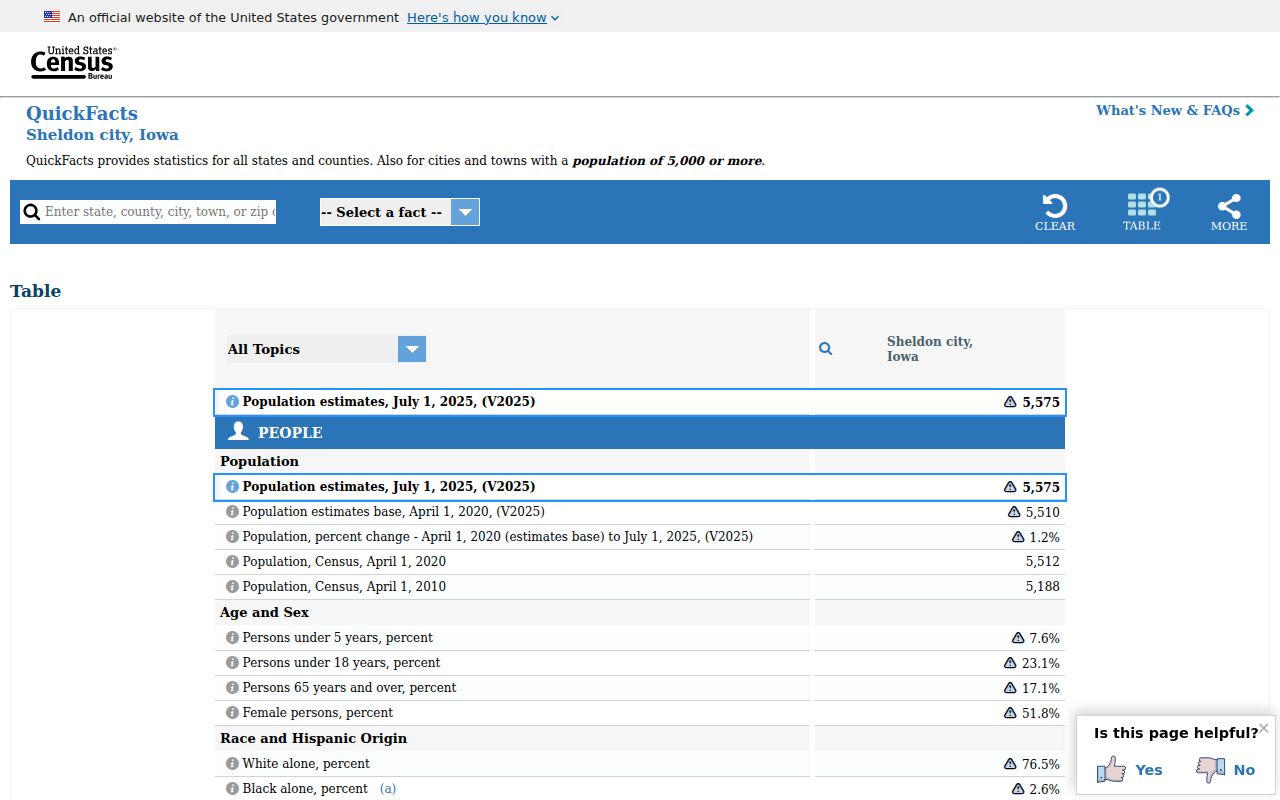
That citywide count covers Sheldon as a whole, so it should never be mistaken for an O'Brien-only measure of residents, police activity, or criminal records.
The Sheldon Police Department
Sheldon maintains its own police department under city ordinance chapter 34. The department creates the first city-level report for calls it investigates. That file may contain the incident narrative, arrest basis, crash material, dispatch or audio references, photographs, video, and other evidence indexes. Some parts can be withheld or redacted under Iowa law.
No dedicated online police-record request portal, fixed copy fee, or published request timetable was found in the official material. Contact the police or city through the official page and describe the exact item. Provide the requester name and contact details, incident number when available, event date and location, record type, relationship when relevant, desired file format, delivery method, and cost limit. Ask for an estimate before a large request.
The official City of Sheldon website provides the municipal identity and city access point pictured here.
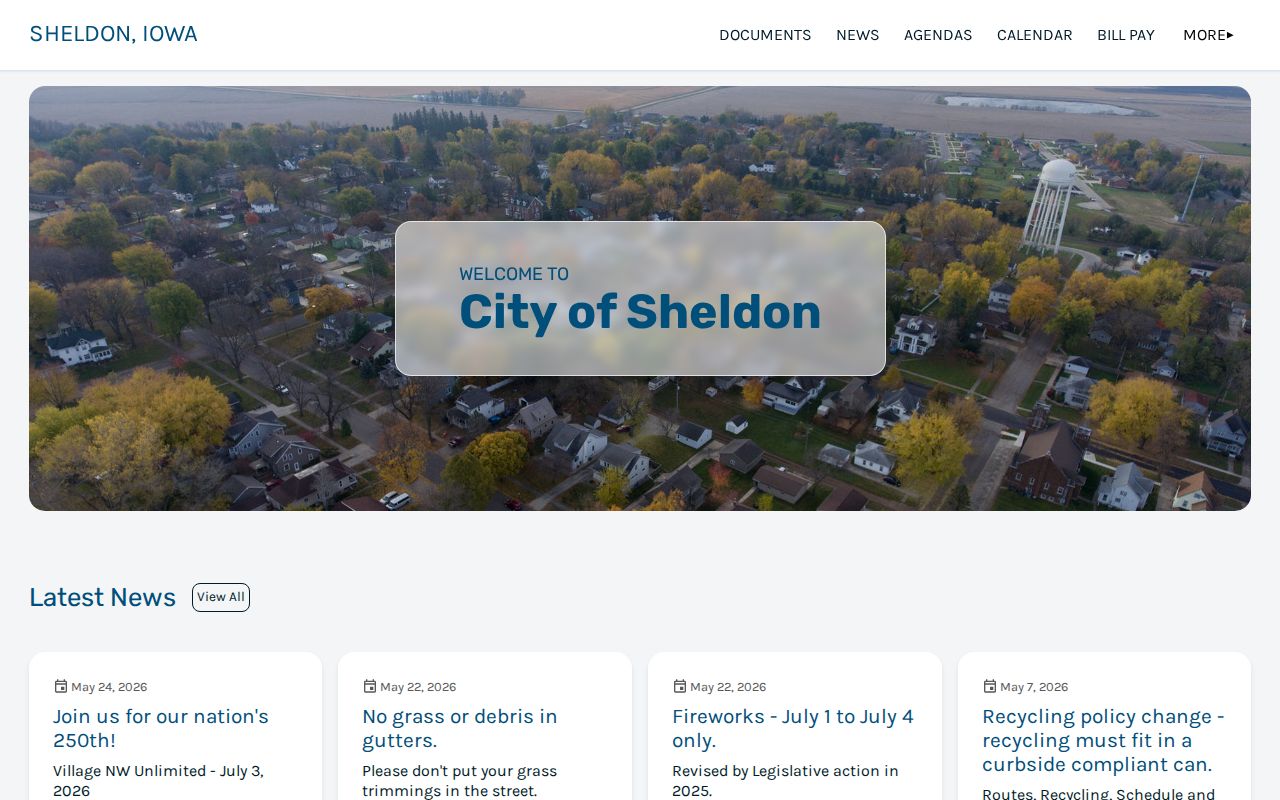
Use the official city path for the Sheldon police contact rather than sending a city report request to the county jail or relying on a private directory.
Sheldon Complaint Form Is Different
The city's citizen compliment and complaint form concerns officer conduct under Iowa Code §80F.1. It is not a public-record request form. Submitting it does not request an incident report, booking file, court docket, or criminal-history response. The two processes have different purposes.
For a police record, contact Sheldon Police Department or the city and say what document is sought. Use the incident number, date, time, location, and record type. If the regular channel does not resolve the request, invoke the Iowa Open Records Law and ask which city custodian holds the file. Do not use the conduct form as a substitute, since that can delay the search and send details into the wrong process.
| Sheldon submission | Purpose | Useful details |
|---|---|---|
| Police record request | Obtain releasable incident, arrest, crash, audio, video, or photo material | Incident number, date, location, exact item, format, and cost limit |
| Citizen compliment or complaint | Address officer conduct under the city's stated process | The form's own required account and contact fields |
| County booking request | Obtain jail intake or custody material | Arrest number, incident number, booking county, and date |
Arrests and Bookings in Sheldon
A Sheldon arrest can create records in more than one office. Sheldon Police Department keeps its probable-cause or incident report. If the person enters the O'Brien County Jail, the sheriff creates a booking record and may place a narrow entry in the official arrest log. The clerk creates a court file only after a charge is filed.
For an O'Brien booking, review the sheriff's arrest log for a recent lead, then call 712-957-5245 for current custody. The log may show the arrest time, arrest number, officer identifier, arresting agency, incident number, and charge description. It is not a live inmate roster and does not prove guilt. The person may have been released, transferred, or held for another county.
If a Sheldon entry names the city police as arresting agency, request the narrative from Sheldon rather than the sheriff. Use the arrest and incident numbers to connect the city report with the county booking. The O'Brien County arrest history resource explains the county jail, log, and custody channels in full.
Sheldon PD Report, County Booking
Dispatch, investigation, and booking are separate jobs. The agency that answers or investigates a Sheldon call owns the report it creates. A county sheriff can dispatch the call or accept the person at jail without taking custody of the police narrative. This split is common in the local paper trail.
Compare the files by identifier, not by title. The city incident record may show the reported facts and investigative steps. The jail booking file focuses on intake, fingerprints, property, charges or holds, bond, and release. The court docket later shows what the prosecutor filed and what happened to each count. An arrest allegation can change or be dismissed.
- Incident number
- The agency's event identifier, useful when requesting the Sheldon police narrative.
- Arrest number
- The arrest-log identifier that can help connect police action with county custody data.
- Booking number
- The jail intake identifier, which is not the same as a court case number.
- Case ID
- The court identifier used to open filed case detail in Iowa Courts Online.
Note: A Sheldon police report, county booking entry, and District Court case can describe one event while carrying different identifiers and dates.
Sheldon Municipal Court Records
Sheldon does not have a separate contemporary municipal-court database. City citations, ordinance matters, traffic cases, and state criminal charges move through Iowa's unified District Court structure. Search Iowa Courts Online in the county of filing. The correct county depends on the event and case, not just the city name.
| Court name | Iowa District Court in the county of filing; no verified standalone Sheldon municipal court portal. |
|---|---|
| Case types | City citations, traffic matters, misdemeanors, felonies, and related state cases within Iowa's unified system. |
| Lookup channel | Iowa Courts Online by name or case number, using O'Brien or Sioux County as the facts require. |
| Docket contents | Case ID, type, parties, filed counts, events, hearings, disposition, sentence, and public financial data. |
| Copies and fees | Ask the clerk in the filing county for unavailable documents, certification, current price, and older-file retrieval. |
Basic public searching is free. Advanced schedule searches and some document links require a subscription or public clerk terminal. Confidential juvenile, sealed, victim-sensitive, and protected identifying material will not appear in the public view.
Search Both Counties for Sheldon Cases
Open Trial Court Case Search, then use Name Search or the exact Case ID. A last or firm name needs at least two letters. The percent sign can act as a wildcard, and a first-name initial should not include a period. Choose AND when both entered names must match; OR returns either.
Run the search once with O'Brien County and again with Sioux County when the incident side is unclear. Open the Case ID and read each count. A dismissed count is not a conviction, and the arrest date may precede the filing date. An older or nonconverted file may require the clerk.
| Search field | Sheldon use | Key detail |
|---|---|---|
| Last or firm name | Primary name search | At least two letters; percent wildcard supported |
| First and middle name | Narrow common-name results | Use an initial without a period |
| County | Locate the filing court | Try O'Brien and Sioux when location is uncertain |
| Case ID or number | Open a known case | The exact identifier reduces false matches |
| Case type | Separate criminal, traffic, and other matters | Use the category shown by the official interface |
Where Sheldon Records End Up
A Sheldon record moves according to the event, custody site, and filing county. Police retain their report. A county jail retains its booking file. The proper District Court clerk holds the filed case, and clerks report dispositions to the Iowa Department of Public Safety Division of Criminal Investigation.
Record flow: Sheldon Police Department › O'Brien or Sioux County booking and District Court › Iowa DCI fingerprint-backed repository
Use city police for recent investigative material, the booking county for custody records, and the filing county for charges and judgment. DCI is a later state layer with its own release limits. A local report can exist even if fingerprints were not submitted and DCI has no arrest cycle.
Sheldon Records by the Numbers
Sheldon had 5,512 residents in the 2020 Census and an estimated 5,584 residents on July 1, 2024, a 1.3 percent increase from the estimate base. Its land area is 4.75 square miles. These figures describe the whole incorporated city across both counties.
Crime counts require more care. An official FBI Crime Data Explorer result should identify the reporting agency, year, coverage, and offense definition. A Sheldon Police Department count cannot be treated as a complete O'Brien County rate, and an O'Brien County aggregate may not describe all of Sheldon. Cross-county geography and partial agency reporting can distort a quick comparison.
Use population data as local context, not as proof about any person or neighborhood. For a specific event, the incident location and record custodian are more useful than a broad rate.
Sheldon Court Records and Counsel
A Sheldon criminal case may show counsel, hearings, pleas, orders, judgment, and sentence in the public docket. A qualifying defendant asks the court for appointed counsel through Iowa's financial-eligibility process. O'Brien County does not operate a separate local public defender office; indigent defense is coordinated through the Iowa Office of the State Public Defender.
The Iowa State Public Defender source is captured in the image below.

That statewide office explains the defense system, while the filing-county court record remains the source for specific Sheldon case events and counsel entries.
Public Access Rules
Iowa's access rules apply to Sheldon police records and District Court files, but they do not make every detail public. Route a city report request to Sheldon. Route booking material to the county jail that created it. Route pleadings, orders, and certified case copies to the filing-county clerk.
Active investigations, confidential sources, juvenile material, medical data, victim-sensitive details, sealed files, and protected peace-officer information may be withheld or redacted. Body-camera review can add time and cost. No uniform Sheldon report fee or dedicated online request form was located, so ask the custodian for an estimate and delivery rules.
Key Iowa laws:
Iowa Open Records Law, chapter 22 provides inspection and copying rights while preserving lawful fees and confidential records.
Iowa Code §§ 692.2-.5 control DCI dissemination, redissemination, and a subject's review or challenge rights.
Iowa Code § 232.147 makes most juvenile court records confidential.
Iowa Code § 80F.1 city process is reflected in Sheldon's conduct form, which is not a record-copy request.
Use the record only for a lawful purpose. An arrest is not proof of guilt, and every court count should be read through its final disposition.